
JH-360DEG Grinding Table Hardfacing Machine
Compact Rotary Hardfacing System for Offline Grinding Table Repair
The JH-360DEG Grinding Table Hardfacing Machine is an automated rotary hardfacing system developed by JINHUA specifically for offline repair and rebuilding of large grinding tables, grinding discs and other circular wear components.
The machine is designed to solve a common problem in traditional grinding table refurbishment: the need for large, complex and space-consuming welding fixtures.
Instead, the JH-360DEG uses a compact rotary structure that integrates heavy-duty rotary support, variable-speed rotation, rotary current transmission, electrical control, wireless communication, welding power integration and circulating cooling control.
When combined with an offline welding manipulator or hardfacing head, the JH-360DEG forms a complete automatic grinding table repair workstation. The system is suitable for continuous high-current hardfacing and provides stable rotation during long welding cycles.
Key Capabilities
Standard capabilities of the JH-360DEG rotary hardfacing platform, covering welding diameter, load, rotation, welding parameters and overlay thickness.
What Is the JH-360DEG Used For?
The JH-360DEG is designed to rotate and support large circular workpieces during automated hardfacing.
Its main application is the offline rebuilding of worn grinding tables used in:
- Vertical roller mills
- Cement mills
- Slag grinding systems
- Coal mills
- Mineral grinding equipment
During repair, the worn grinding table is positioned on the rotary platform.
The JH-360DEG then provides controlled workpiece rotation while an external welding manipulator or hardfacing system deposits wear-resistant alloy onto the worn surface.
The basic working principle is:
Grinding Table Rotation + Welding Torch Positioning + Continuous Hardfacing
This allows the grinding table surface to be rebuilt in a controlled and repeatable manner.

Rotary platform — the worn grinding table positioned and rotated during automated hardfacing.

Grinding table rebuilding — the worn surface rebuilt with wear-resistant hardfacing alloy.
Designed for Offline Grinding Table Rebuilding
Grinding tables operate continuously under severe pressure and abrasive material flow.
Over time, the surface profile gradually wears and may suffer:
- Abrasive wear
- Uneven material loss
- Reduced grinding profile
- Damaged hardfacing layers
- Local cracking
- Reduced operating efficiency
Instead of replacing the complete grinding table, the worn surface can be rebuilt using wear-resistant hardfacing alloy.
The JH-360DEG provides the rotary platform required for this repair process.
Compact Alternative to Large Repair Fixtures
Traditional offline grinding table hardfacing often requires large customized fixtures.
These systems can require:
- Large workshop space
- Complex workpiece positioning
- Heavy structural frames
- Long installation time
The JH-360DEG uses a more compact rotary structure to support, rotate and electrically connect the workpiece.
This reduces the amount of specialized tooling required for suitable grinding table repair applications.
The compact structure also makes it easier to integrate the system into an existing hardfacing workshop.

Compact rotary structure — support, rotation and electrical connection in one platform.
How the JH-360DEG Works
The JH-360DEG provides workpiece rotation and support, while an external welding system provides the welding motion and parameters. Together they form a complete hardfacing workstation.
The JH-360DEG itself primarily controls:
- Workpiece support
- Workpiece rotation
- Rotary electrical conduction
- Rotation speed
- Cooling-related electrical functions
An external offline welding system controls:
- Welding torch position
- Welding travel
- Wire feeding
- Oscillation
- Welding parameters
For example:
- The worn grinding table is mounted on the JH-360DEG.
- The welding manipulator is positioned above the worn area.
- Welding parameters are set.
- The JH-360DEG rotates the workpiece at the programmed speed.
- The welding torch deposits wear-resistant alloy continuously.
- The torch position is gradually adjusted across the table surface.
- Additional layers are applied until the required profile is restored.

Rotation + torch positioning — the workpiece rotates while the welding head deposits alloy.
Typical Grinding Table Repair Process
A ten-stage offline repair process, from inspection of the grinding table through to final inspection before returning the component to service.
Inspect the Grinding Table
Evaluate the condition of the table before any material is removed.
- Wear profile
- Cracks
- Existing overlay
- Base material
- Required final dimensions
Surface Preparation
Remove damaged or unsuitable material by grinding, machining or gouging where required.
Mount the Workpiece
Position and secure the grinding table on the JH-360DEG rotary platform.
Install the Welding System
Position the external hardfacing manipulator over the required welding area.
Set Rotation Speed
Adjust workpiece rotation according to the diameter and welding process.
Set Welding Parameters
Configure the welding parameters before starting the automatic cycle.
- Welding current
- Welding voltage
- Wire feed rate
- Oscillation
- Overlay thickness
- Welding position
Start Automatic Hardfacing
The grinding table rotates while the welding system deposits wear-resistant alloy.
Rebuild the Complete Surface
The welding head gradually moves across the worn surface until the required area is restored.
Apply Additional Layers
Additional welding layers are applied where required.
Final Inspection
Check surface profile, overlay thickness, welding quality and required dimensions before returning the component to service.

Repair process — mounting, rotation and hardfacing of the grinding table.
Typical Applications
The JH-360DEG is suitable for offline hardfacing of:
Industries
Cement Industry
Typical applications:
- Raw mill grinding tables
- Cement mill grinding tables
- Slag mill tables
- Coal mill tables
Mining
Typical applications:
- Large grinding components
- Circular wear components
Power Generation
Typical applications:
- Coal grinding tables
- Wear-resistant mill components
Heavy Industry
Other circular wear components can also be evaluated according to geometry and load.
Technical Specifications
Standard configuration data for the JH-360DEG grinding table rotary hardfacing machine.
| Parameter | Specification |
|---|---|
| Model | JH-360DEG |
| Machine Type | Grinding Table Rotary Hardfacing Machine |
| Main Application | Offline Grinding Table / Grinding Disc Repair |
| Welding Diameter Range | 100–6500 mm |
| Workpiece Height | 500–1500 mm |
| Welding Wire Diameter | Ø1.2–2.8 mm flux-cored wire |
| Single-Layer Overlay Thickness | 2.5–6.5 mm |
| Rotation Speed | 0.05–1.2 rpm |
| Maximum Workpiece Load | 1300 kg |
| Oscillation Speed | 0.1–3.5 m/min |
| Oscillation Width | Approx. 5–100 mm* |
| Welding Voltage | 20–35 V |
| Welding Current | 300–700 A |
| Rotation Control | Variable-Frequency Stepless Control |
| Current Transmission | Rotary Current Conduction |
| Cooling | Variable-Frequency Circulating Cooling |
| Operation | Automatic / Manual Adjustment |
*Final oscillation range should be confirmed according to the selected welding head.
Standard machine configuration — rotary platform, drive system and electrical control.
Main System Configuration
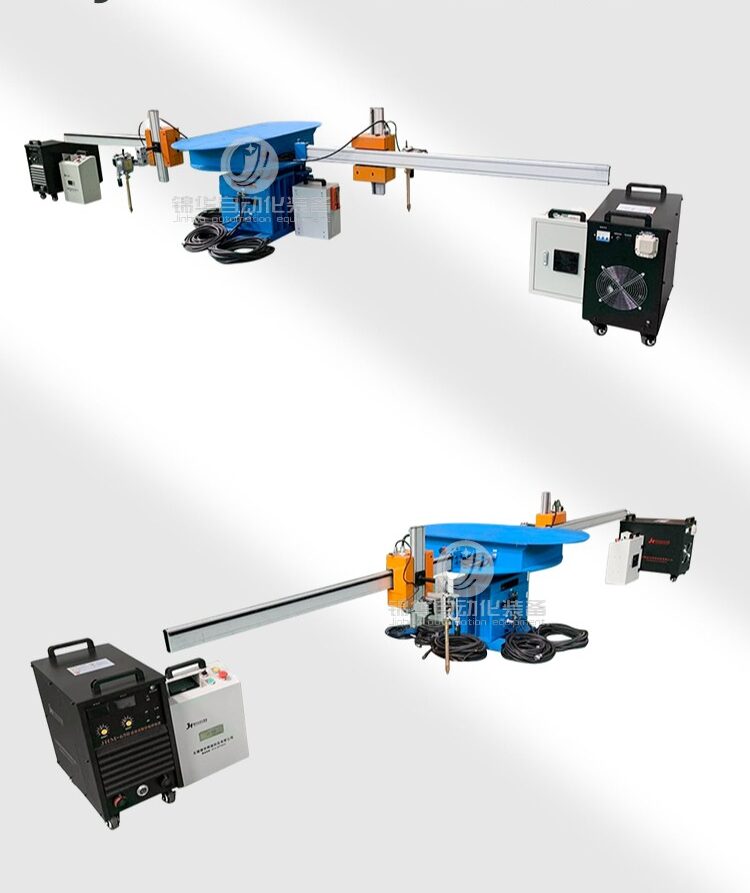
A typical JH-360DEG system includes the rotary platform, drive and control components listed below.
A typical JH-360DEG system includes:
- Main rotary platform
- Primary reduction system
- Secondary rotary platform
- Workpiece support structure
- Rotary current transmission unit
- Variable-frequency drive
- Cooling control system
- Electrical cabinet
- Wireless control system
- Welding power interface
Required / Matching Equipment
Depending on the application:
- Offline welding manipulator
- Hardfacing power source
- Flux-cored wire feeder
- Welding torch
- Oscillation unit
- Preheating equipment
- Automatic air carbon arc gouging system

System configuration — rotary platform combined with an offline welding manipulator.
JH-360DEG vs. JH-T3200
The JH-360DEG and JH-T3200 are often used together, but they perform different functions.
| Feature | JH-360DEG | JH-T3200 |
|---|---|---|
| Main Function | Rotate and support workpiece | Position and move welding torch |
| Equipment Type | Rotary hardfacing platform | Column-and-boom welding manipulator |
| Main Workpiece | Grinding table / disc | Grinding roller / table |
| Rotation | Yes | No |
| Workpiece Support | Yes | No |
| Welding Torch Positioning | External system | Main function |
| Rotary Current Conduction | Yes | Not primary function |
| Max. Standard Load | 1300 kg | Depends on positioner |
| Best Use | Circular workpiece rotation | Welding head positioning |
Combined Workstation
For a complete offline grinding table hardfacing system:
- JH-360DEG = Workpiece Rotation
- JH-T3200 / Other Welding Manipulator = Torch Movement
- Hardfacing Power Source = Welding Energy
This combination forms a complete automated grinding table rebuilding workstation.
Why Choose JH-360DEG?
Seven practical reasons why the JH-360DEG is built around offline grinding table hardfacing rather than being a general-purpose welding positioner.
Purpose-Built for Grinding Tables
Unlike a general-purpose welding positioner, the JH-360DEG is developed specifically around offline grinding table hardfacing.
Compact Structure
The machine reduces reliance on large customized welding fixtures.
Wide Diameter Capability
Supports circular workpieces from approximately 100 mm up to 6500 mm depending on geometry.
Stable Low-Speed Rotation
0.05–1.2 rpm variable-speed rotation allows process adjustment for different workpiece diameters.
High-Current Operation
Designed for continuous industrial hardfacing up to approximately 700 A.
Rotary Current Transmission
Integrated electrical conduction supports continuous welding while the workpiece rotates.
Easy Integration
The platform can be combined with existing offline hardfacing equipment or a complete JINHUA welding manipulator.
Tell Us Your Grinding Table Requirements
For a technical proposal, please provide:
- 01 Grinding table outer diameter
- 02 Inner diameter
- 03 Workpiece height
- 04 Total weight
- 05 Workpiece drawing
- 06 Base material
- 07 Existing overlay material
- 08 Wear depth
- 09 Required overlay thickness
- 10 Required hardness
- 11 Welding wire specification
- 12 Required production capacity
- 13 Existing welding manipulator, if available
- 14 Factory power supply
- 15 Destination country
JINHUA engineers will evaluate whether the JH-360DEG standard configuration is suitable or whether a customized rotary hardfacing platform is required.
Request a Technical Proposal
Complete the form and JINHUA engineers will evaluate whether the standard configuration is suitable or whether a customized rotary hardfacing platform is required.
Frequently Asked Questions
Common questions about the JH-360DEG working range, configuration and matching equipment.
It is mainly used as a rotary hardfacing platform for offline rebuilding of VRM grinding tables, grinding discs and other circular wear components.
The JH-360DEG mainly provides workpiece rotation, support and electrical conduction.
It should be combined with a welding manipulator, welding head and hardfacing power source to form a complete automated hardfacing system.
The specified diameter range is approximately 100–6500 mm.
Final compatibility depends on the workpiece dimensions, weight and center of gravity.
The standard specified maximum load is 1300 kg. Heavier workpieces require customized engineering evaluation.
The specified range is approximately Ø1.2–2.8 mm flux-cored hardfacing wire.
Approximately 2.5–6.5 mm per layer, depending on welding parameters.
Yes. The JH-360DEG can control workpiece rotation while the JH-T3200 controls welding torch position.
Together they can form a complete offline grinding table repair workstation.
Yes. Rotation range, load capacity, workpiece support, welding power and matching welding equipment can be customized according to the grinding table drawing.