
JH-6000DEG Automatic Roll Hardfacing Machine
Automated hardfacing for continuous casting rolls, mill rolls and industrial rollers.
The JH-6000DEG Roll Hardfacing Machine is an automated welding system developed for rebuilding and surface hardfacing of large industrial rolls.
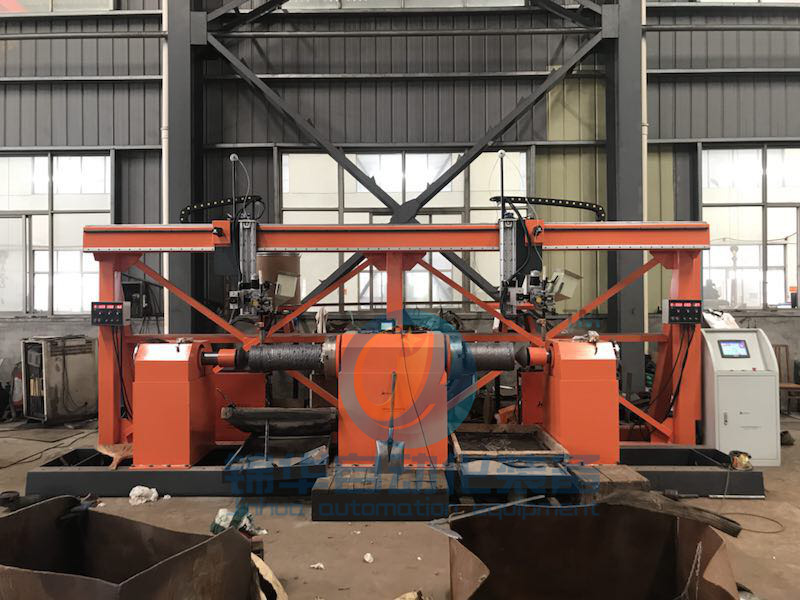
The machine uses a headstock and movable tailstock with dual chuck clamping, combined with dual workstations and independent spindle drives.
Roll Rebuilding Capacity
The JH-6000DEG is built for large cylindrical workpieces, with servo-driven carriage movement and precision linear modules that help maintain stable torch positioning and consistent weld bead formation.
Typical Applications
The JH-6000DEG is designed for hardfacing repair and rebuilding of:
Roll Types
- Continuous casting rolls
- Steel mill rolls
- Extrusion rolls
- Guide rollers
- Heavy-duty industrial rollers
Typical Users
- Steel mills
- Continuous casting plants
- Cement plants
- Roll repair workshops
- Heavy equipment maintenance companies
Dual-Station Roll Hardfacing
One of the main advantages of the JH-6000DEG is its flexible dual-station design. The machine can be configured to:
Weld Two Rolls Simultaneously
Two independently driven workpieces can be processed at the same time to improve workshop productivity.
Weld One Roll with One Head
Suitable for conventional repair work or smaller production batches.
Weld One Roll with Two Welding Heads
Two welding heads can work on the same roll according to the welding procedure, helping improve deposition efficiency for suitable applications.

Dual workstations with independent spindle drives — two rolls can be hardfaced at the same time.
Headstock, Tailstock and Dual Chuck Clamping
The machine uses a headstock and movable tailstock with dual chuck clamping, combined with dual workstations and independent spindle drives. Servo-driven carriage movement and precision linear modules help maintain stable torch positioning and consistent weld bead formation.
The system supports both open-arc hardfacing and submerged-arc hardfacing, making it suitable for maintenance and remanufacturing of worn industrial rolls.
Automatic Welding Control
The PLC and touchscreen control system allows operators to set and monitor major welding parameters including:
- Welding current
- Welding voltage
- Wire feeding speed
- Travel speed
- Travel distance
- Oscillation width
- Oscillation speed
- Roll rotation speed
- Welding time
- Number of overlay layers
After entering the roll diameter and roll body length, the control system can assist in setting suitable rotational speed and weld bead overlap. Chinese and English touchscreen interfaces are available.
Chinese / English interface / Automatic + Manual operation / PLC + Touchscreen
PLC + touchscreen control — welding parameters, motion and overlay layers set from one interface.

Touchscreen parameter interface — roll diameter and body length assist rotational speed and bead overlap setting.
Multiple Hardfacing Processes
The JH-6000DEG supports several welding modes.
Open-Arc Hardfacing
Suitable for automated hardfacing using appropriate flux-cored welding wire.
Submerged-Arc Hardfacing
Suitable for mechanized high-deposition surfacing using welding wire and granular flux.
Oscillation Hardfacing
The welding torch performs controlled lateral oscillation to increase bead width and improve surface coverage.
Choosing the Correct Process
The correct process depends on the roll material, required hardness, overlay alloy and repair depth.
Submerged-arc applications: an optional flux recovery system can automatically screen and recover reusable flux during production.

Open-arc and submerged-arc hardfacing — selected according to roll material, hardness and repair depth.
Stable Wire Feeding and Oscillation
The wire feeding system is designed for stable high-torque operation during continuous hardfacing.
Oscillation welding helps improve:
- Weld bead width
- Deposition efficiency
- Surface coverage
- Weld bead flatness
- Overlay uniformity
The combined effect of stable wire feeding, controlled rotation and oscillation helps create a more consistent rebuilt roll surface.
* Final oscillation range should be confirmed according to the selected welding head configuration.
Wire feeding and oscillation — stable high-torque feeding with controlled lateral oscillation.

Wire feeder & torch oscillator — the oscillation unit is listed as optional equipment.
Automatic Welding Cycle
A typical hardfacing process includes six stages, from mounting the workpiece to the automatic stop at the end of the program.
Load and Clamp the Roll
Mount the workpiece between the headstock and movable tailstock.
Position the Welding Torch
Adjust the torch to the required starting position.
Set Welding Parameters
Enter welding mode, current, voltage, wire feed, rotation speed and oscillation parameters.
Start Automatic Hardfacing
The machine automatically starts the welding sequence and workpiece rotation.
Automatic Overlay Welding
The system controls rotation, travel and oscillation according to the preset program.
Complete the Welding Cycle
After the programmed welding is completed, the machine automatically stops.

Automatic overlay welding — rotation, travel and oscillation controlled by the preset program.
Optional Flux Recovery
For submerged-arc applications, an optional flux recovery system can automatically screen and recover reusable flux during production.
- Automatically screens reusable flux
- Reduces flux consumption during continuous production
- Included in the optional equipment list
Main Configuration
The standard system mainly includes the following units, with optional equipment available according to the welding process.
Standard Configuration
- Main machine frame
- Headstock
- Movable tailstock
- Dual chuck clamping system
- Dual spindle drive
- Welding carriage
- Servo drive system
- Welding torch positioning modules
- Hardfacing power supply
- Wire feeding system
- PLC control system
- Touchscreen HMI
- Pneumatic or hydraulic system
Optional Equipment
- Welding torch oscillator
- Flux recovery system
- Single or multiple welding power sources
- Preheating system
- Post-weld annealing / heat treatment system
Optional equipment is selected according to the roll material, overlay alloy and required welding procedure.
Technical Specifications
Standard configuration of the JH-6000DEG automatic roll hardfacing machine.
JH-6000DEG — Main Technical Parameters
| Parameter | Specification |
|---|---|
| Model | JH-6000DEG |
| Welding Process | Submerged Arc / Open Arc |
| Maximum Clamping Length | 6000 mm |
| Workpiece Diameter | Ø100–1200 mm |
| Maximum Workpiece Weight | 6000 kg |
| Machine Dimensions | Approx. L10000 × W2000 × H2350 mm |
| Oscillation Width | 5–50 mm* |
| Oscillation Speed | 0.1–3.5 m/min |
| Roll Rotation Speed | 0.05–0.3 rpm |
| Welding Voltage | 28–35 V |
| Welding Current | 300–450 A |
| Machine Color | Orange / Customized |
| Control System | PLC + Touchscreen |
| Operation Mode | Automatic + Manual |
* Final oscillation range should be confirmed according to the selected welding head configuration.
Operating Environment
| Requirement | Specification |
|---|---|
| Ambient Temperature | -10°C to +40°C |
| Relative Humidity | ≤95%, non-condensing |
| Workshop Environment | Well ventilated, without severe impact or vibration |
| Power Frequency | 50 Hz |
| Power Supply | Customized according to destination country |

Machine layout drawing — overall dimensions and floor space requirement.
Machine Details
Headstock and tailstock, dual chuck clamping, welding carriage, wire feeding, oscillation and control units of the standard JH-6000DEG platform.

Machine structure — main frame, carriage and roll support system.

Machine configuration — headstock, tailstock and welding carriage layout.
Welding carriage & torch module — servo-driven movement along the roll body.

Workshop installation — roll hardfacing machine prepared for production.
Machine overview — dual-station roll hardfacing platform.
Machine detail — mechanical modules and drive components.

Headstock, dual chuck clamping & movable tailstock — workpiece mounting for large diameter rolls.

Optional flux recovery system — screening and recovery of reusable submerged-arc flux.

Rebuilt roll surface after hardfacing — consistent bead overlap and a flat rebuilt surface.
Why Choose the JH-6000DEG?
The JH-6000DEG is designed for customers who need to rebuild large rolls instead of replacing them. Its main advantages include:
- Handles rolls up to 6 meters long
- Maximum workpiece weight up to 6 tons
- Dual-station production capability
- Open-arc and submerged-arc process options
- Automatic roll rotation and welding travel
- Programmable oscillation hardfacing
- Stable servo-controlled movement
- Repeatable welding parameters
- Reduced dependence on manual welding
- Suitable for industrial roll repair workshops
Roll before / after hardfacing — rebuilding worn rolls instead of replacing them.
Rebuild Instead of Replace
The JH-6000DEG is an automated welding system developed for rebuilding and surface hardfacing of large industrial rolls.
Tell Us Your Roll Repair Requirements
For a technical proposal, please provide the following information. JINHUA engineers will evaluate the workpiece and recommend the appropriate hardfacing configuration.
- 01 Roll Type
- 02 Roll Material
- 03 Roll Diameter
- 04 Roll Body Length
- 05 Total Workpiece Weight
- 06 Worn Layer Thickness
- 07 Required Overlay Thickness
- 08 Required Hardness
- 09 Welding Wire Specification
- 10 Preferred Welding Process
- 11 Required Production Capacity
- 12 Factory Power Supply
Request a Technical Proposal
Complete the form and JINHUA engineers will evaluate the workpiece and recommend the appropriate hardfacing configuration.
Frequently Asked Questions
Common questions about roll hardfacing and roll rebuilding on the JH-6000DEG.
What types of rolls can the JH-6000DEG repair?
The machine can be used for continuous casting rolls, mill rolls, extrusion rolls and other cylindrical industrial workpieces within the specified size and weight range.
What is the maximum roll size?
The standard machine supports a maximum length of 6000 mm, a diameter range of Ø100–1200 mm and a maximum weight of 6000 kg.
Can it perform submerged-arc welding?
Yes. The machine supports submerged-arc hardfacing and can also be configured for open-arc hardfacing.
Can two rolls be welded at the same time?
Yes. The dual-station, dual-spindle configuration allows two workpieces to be hardfaced simultaneously when the selected welding configuration permits.
Can the machine weld one roll with two welding heads?
Yes. Depending on the welding process, one workpiece can also be processed using two welding heads simultaneously.
Can the machine be customized?
Yes. JINHUA can customize the clamping length, workpiece diameter, workpiece weight capacity, number of welding heads, welding power sources, oscillation system, flux recovery, preheating and post-weld heat treatment.