
JH-800F 4-Torch Wear Plate Hardfacing Machine
High-efficiency automated overlay welding for wear plate production.
An integrated automatic welding system for hardfaced wear-resistant plates — four independent torches and four wire feeders working in parallel, bidirectional welding programs, automatic powder feeding, motorized torch oscillation and PLC touchscreen control.
- Technical proposal prepared within 1–2 working days after receiving your plate data.

What Is the JH-800F Wear Plate Hardfacing Machine?
An automated flat-plate overlay welding system designed to deposit a wear-resistant alloy layer onto a steel base plate.
Welding wire and alloy powder are continuously supplied to the welding area while the welding torches move according to preset process parameters. The oscillation system controls the welding bead width and overlap, while the machine movement system controls the welding path and travel speed.
The result is a metallurgically bonded bimetallic wear-resistant plate consisting of a structural steel base plate and a hardfaced wear-resistant surface. When suitable chromium carbide welding consumables are used, the machine can be configured for chromium carbide overlay plate (CCO plate) production.
The JH-800F is designed for wear plate manufacturers that require:
- Higher production capacity from the same floor space
- Repeatable, recipe-based welding parameters
- Multiple welding heads working in parallel
- Controlled weld bead overlap
- Stable wire feeding and automatic powder feeding
- Flexible overlay thickness from 2 mm to 40 mm
- Reduced dependence on manual welding
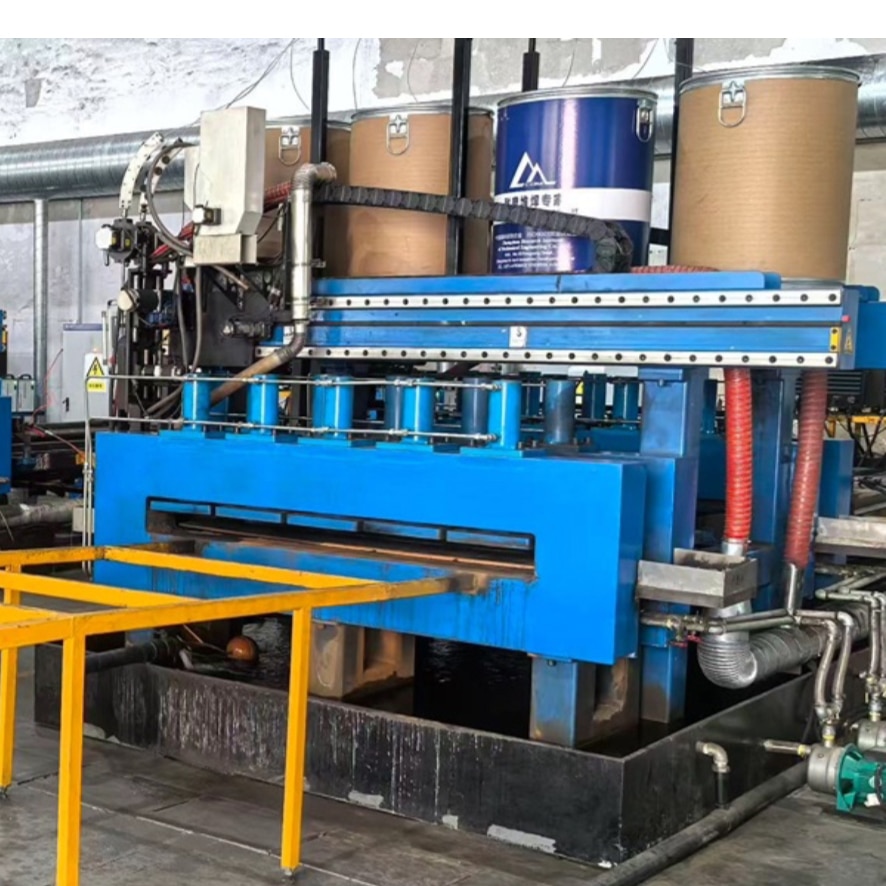
Automated overlay welding platform — four torches, four wire feeders and one integrated control system.
Four-torch welding head — parallel overlay welding in one pass.
Why Use Four Welding Torches?
Four welding systems operate in parallel, allowing multiple overlay tracks to be deposited during the same production cycle. Compared with machines using fewer welding torches, a four-torch system can significantly improve effective plate production capacity under comparable welding parameters.
The main advantage of the JH-800F is its four-torch four-wire welding configuration. Actual output depends on the parameters below — and for customers planning a wear plate production plant, JINHUA can calculate the recommended machine configuration according to the required m²/hour, plates/day or tons/month production target.
Process variables
Plate dimensions, base plate thickness, required overlay thickness, welding wire diameter, current and voltage.
Motion variables
Travel speed, oscillation width, number of overlay layers, alloy composition and cooling requirements.
Key Features of the JH-800F
Ten integrated systems working together: welding, wire feeding, powder feeding, oscillation, motion, control and cooling.
Four-Torch Four-Wire Welding System
Four independent wire feeders and four water-cooled welding torches are installed for simultaneous overlay welding. The configuration is designed for continuous wear plate production and provides a practical solution for manufacturers seeking higher output without sacrificing welding parameter control.
Bidirectional Welding Mode
The control system is preset with a bidirectional welding program. The welding carriage can perform overlay welding in both directions, reducing unnecessary return travel and helping improve effective machine utilization. Additional welding modes can be developed according to the customer’s production requirements.
Automatic Powder Feeding System
A gear-type powder feeding mechanism driven by high-precision stepper motors keeps powder delivery stable during hardfacing and allows the welding process to be adjusted for different overlay compositions. The machine is equipped with 4 sets of automatic dual-disc powder feeding systems.
Adjustable Torch Oscillation
The welding torch oscillation system uses a brushless motor and reducer, with oscillation speed continuously adjustable from 0–130 cycles/min. Oscillation helps control welding bead width, bead overlap, surface coverage, overlay uniformity and welding efficiency.
Electric Oscillation Width Adjustment
Instead of relying entirely on manual mechanical adjustment, the oscillation width can be electrically adjusted. The operator controls the motorized mechanism to increase or decrease the oscillation width according to the required welding bead and overlay process — making process changes easier when switching plate specifications.
Stable High-Torque Wire Feeding
Each welding station uses a customized aluminum wire-feeder housing combined with a high-torque stepper motor for stable wire feeding, adjustable feeding speed, high driving torque and continuous operation capability. Four independent wire straightening systems improve wire feeding stability before the wire reaches the torch.
650-Series Hardfacing Welding Power Supply
The JH-800F is designed to work with a 650-series hardfacing welding power supply developed for overlay welding applications, providing stable welding output for continuous production. The final power configuration is selected according to wire type, wire diameter, deposition rate, overlay alloy, plate specification and production capacity.
PLC Digital Control
The machine uses a XINJE PLC control system as the main control unit. The operator manages the welding process through the control interface and touchscreen, and major operating parameters can be adjusted according to the production recipe — improving repeatability between different plates and production batches.
Wireless Remote Control
A wireless remote controller is provided for auxiliary machine operation, allowing operators to perform selected machine movements and adjustments without remaining beside the main electrical cabinet. It is particularly useful during plate positioning, machine setup, torch adjustment, commissioning and maintenance.
Water-Cooled Welding Torches
Four water-cooled welding torches support continuous hardfacing operation. Effective torch cooling improves thermal stability during long-duration welding and helps extend the service life of welding components.
Systems You Can Inspect Before You Buy

Torch & wire feeding station — 4 torches, 4 feeders, 4 straightening units.
Torch oscillation unit — brushless motor + reducer, electric width adjustment.
Automatic powder feeding — 4 sets of dual-disc feeders, stepper-driven.
PLC control cabinet & touchscreen — XINJE PLC system, recipe-based parameters.
Plate pushing platform & hydraulic station — 16 hydraulic cylinders, rack & pinion drive.
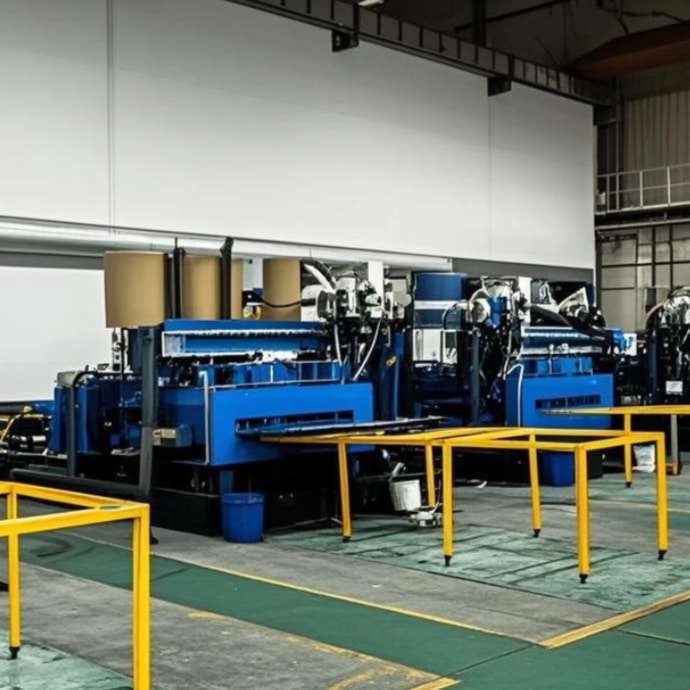
Production environment — dust extraction ducting, cable drag chains and long-run welding.
Typical Wear Plate Production Process
The JH-800F provides an integrated workflow for automated wear plate hardfacing — from plate loading to the finished bimetallic plate.
Load Base Plate
The steel base plate is placed on the supporting platform.
Position & Secure the Plate
The plate positioning system helps maintain the required welding position.
Set Welding Parameters
The operator enters or adjusts welding speed, oscillation parameters, wire feeding and other process settings.
Start Wire & Powder Feeding
Four wire feeders and automatic powder feeding units supply welding consumables continuously.
Four-Torch Overlay Welding
Four welding torches deposit the wear-resistant layer simultaneously.
Bidirectional Welding
The system performs the programmed welding sequence in both directions.
Single or Multiple Layer Hardfacing
Additional welding layers can be applied according to the required overlay thickness.
Remove the Finished Wear Plate
After welding and cooling, the finished plate can be transferred for cutting, forming or further fabrication.
What Plates Can the JH-800F Produce?
The machine is designed for the production of different types of welded overlay wear plates.
Hardfaced Wear Plate
A steel base plate covered with a welded wear-resistant alloy layer for severe abrasive environments.
Bimetallic Wear Plate
Combines the structural properties of base steel with the wear resistance of the deposited alloy layer.
Chromium Carbide Overlay Plate
Produced with suitable chromium carbide welding wire, alloy powder and welding parameters.
Multi-Layer Wear Plate
Single-layer or double-layer welding selected according to final overlay thickness and wear resistance.
Typical Base Materials
The machine can be used with common base plate materials including Q235, Q345, low-carbon steel and stainless steel. Suitability depends on the required overlay alloy, welding procedure and final application.
Using another steel grade? Send us the material grade, base plate thickness and required overlay thickness for technical evaluation.
Hardfacing wire & alloy powder — consumables are selected according to the required overlay alloy and hardness.
Applications of the Finished Wear Plates
Wear plates produced with automated hardfacing equipment are commonly fabricated into wear liners and wear-resistant components for industries with severe abrasion and impact.
Mining & Earthmoving
Wear liners for chutes, hoppers, crushers, transfer points and material handling systems.
Cement Industry
Wear-resistant liners for grinding systems, separators, ducts, chutes and material conveying equipment.
Steel Industry
Wear liners and components for raw-material handling, sintering, conveying and processing systems.
Power Industry
Wear-resistant parts for coal handling, ash handling and bulk material transportation systems.
Construction Materials
Wear protection solutions for equipment processing abrasive raw materials.
Recycling & Bulk Material Handling
Wear liners for shredding, conveying, sorting and material transfer equipment.
From machine to wear part — finished plates are cut, formed and fabricated into wear liners.
One Machine, Many Wear Parts
A single overlay plate can be cut into liners, chute plates, hopper plates, crusher wear parts and bucket liners. Because the wear layer is welded rather than mechanically attached, the plate can be cut to shape and formed without delamination of the overlay.
- Chute, hopper and transfer point liners
- Crusher and shredder wear parts
- Bucket and loader liners
- Conveyor and material handling wear surfaces
Technical Specifications
Standard configuration of the JH-800F four-torch four-wire wear plate hardfacing machine.
JH-800F — Main Technical Parameters
| Model | JH-800F |
|---|---|
| Machine Type | Four-Torch Four-Wire Wear Plate Hardfacing Machine |
| Welding Width | ≤1500 mm, customizable |
| Standard Welding Length | 3000 mm |
| Extended Plate Length | Up to 6000 mm by plate repositioning |
| Rapid Travel Speed | 0–3000 mm/min |
| Hardfacing Mode | Single-layer / Double-layer |
| Base Materials | Q235, Q345, low-carbon steel, stainless steel |
| Overlay Thickness | 2–40 mm |
| Hardfacing Speed | 100–300 mm/min |
| Torch Vertical Adjustment | 0–100 mm |
| Torch Height Adjustment | Electric |
| Linear Positioning Accuracy | ±0.1 mm / 1000 mm |
| Speed Error | ±2% |
| Control System | XINJE PLC |
| Torch Quantity | 4 |
| Wire Feeding Systems | 4 |
| Water-Cooled Welding Torches | 4 |
| Automatic Powder Feeders | 4 sets |
| Welding Modes | Bidirectional welding + customizable modes |
Machine dimensions, welding area, control system and production configuration can be customized according to the customer’s plate specifications and production capacity.
Need a Different Working Area?
Working width, plate length, torch quantity, control configuration and production capacity can all be adapted to your product range.
- Custom welding width and plate length
- Custom torch quantity and spacing
- Factory voltage and power supply adapted
- Dust extraction and cooling options
Machine layout drawing — overall dimensions and floor space requirement.
Main Machine Configuration
The complete system configuration of the standard JH-800F platform.
JH-800F — System Configuration
| System | Configuration | Qty / Type |
|---|---|---|
| Machine Structure | Horizontal type | — |
| Guide Rail Spacing | 160 mm | — |
| Guide Rail | LGD 12 * | 4 pcs |
| Main Drive | Servo drive | — |
| Control System | XINJE PLC system | — |
| Electrical Control System | Complete cabinet | 1 set |
| Plate Pushing Platform | Integrated platform | 1 set |
| Plate Pushing Motor | Motor unit | 1 unit |
| Plate Pusher Reducer | NMRV90/60 horizontal reducer | 1 set |
| Hydraulic Station | Hydraulic power unit | 1 unit |
| Hydraulic Cylinders | Plate clamping / positioning | 16 sets |
| Hydraulic Piping | Complete set | 1 set |
| Wire Feeders | Independent wire feeding stations | 4 sets |
| Water-Cooled Welding Torches | Continuous hardfacing torches | 4 sets |
| Plate Pusher Drive Module | Closed-loop stepper motor + worm gear reducer | — |
| Plate Pusher Transmission | Rack & pinion + customized guide rail | — |
| Plate Pusher Cable Drag Chain | Cable protection chain | 1 set |
| Welding Carriage Drive | XINJE servo + reducer | 2 sets |
| Welding Carriage Transmission | Rack & pinion + linear guide | 2 sets |
| Welding Carriage Cable Drag Chain | Cable protection chain | 2 sets |
| Automatic Powder Feeding System | Dual-disc type | 4 sets |
| Welding Wire Straightening System | Independent straighteners | 4 sets |
| Dust Extraction Ducting | Fume extraction connections | 2 sets |
| Machine Color | Marine blue / orange-red / customized | — |
* Exact guide rail model should be confirmed according to the final technical configuration.
Designed for Stable and Repeatable Wear Plate Production
Producing a consistent hardfaced wear plate requires more than simply creating a welding arc. The final plate quality is affected by the coordinated control of the variables below — the JH-800F integrates these major welding and motion systems into one automated production platform, helping manufacturers improve production repeatability and reduce dependence on manual welding operations.
Weld bead overlap & uniformity — the visible result of coordinated process control.
JH-800F vs. Conventional Hardfacing Production
How an automated four-torch platform compares with manual or low-automation hardfacing.
| Feature | JH-800F Automatic System | Manual / Low-Automation Welding |
|---|---|---|
| Welding Torches | 4 | Usually 1 or fewer automated heads |
| Parallel Welding | Yes | Limited |
| Welding Direction | Bidirectional | Process dependent |
| Wire Feeding | Automatic | Manual / semi-automatic |
| Powder Feeding | Automatic | Manual or separate system |
| Torch Oscillation | Motorized | Manual / basic |
| Oscillation Adjustment | Electric | Often manual |
| PLC Control | Yes | Limited |
| Wireless Control | Yes | Usually unavailable |
| Single / Double Layer | Supported | Process dependent |
| Repeatability | High | Operator dependent |
| Production Scalability | Designed for production | More limited |
Who Is the JH-800F Best Suited For?
The JH-800F is particularly suitable for manufacturers and service providers working with welded overlay wear plates.
- Wear plate manufacturers
- Chromium carbide overlay plate manufacturers
- Hardfacing workshops
- Wear liner manufacturers
- Welding automation companies
- Mining equipment component manufacturers
- Cement industry wear-part suppliers
- Steel mill maintenance and wear solution suppliers
- Companies establishing a new overlay plate production line
- Factories upgrading from single- or double-torch hardfacing equipment
Customization Available
Wear plate production requirements vary significantly between manufacturers. JINHUA can customize the hardfacing system according to your product range and production target.
For higher production capacity or non-standard plate dimensions, our engineering team can evaluate a customized machine configuration.
Customized builds — non-standard machine configurations.
On-site commissioning — installation, commissioning and operator training.
Tell Us Your Wear Plate Requirements
To recommend the correct hardfacing machine and prepare a technical proposal, please send us the following information.
- 01 Base plate material
- 02 Base plate thickness
- 03 Plate width × length
- 04 Required overlay thickness
- 05 Single-layer or multi-layer overlay
- 06 Hardfacing wire type and diameter, if already determined
- 07 Required plate hardness or alloy composition
- 08 Expected production capacity — m²/day, plates/day or tons/month
- 09 Factory power supply
- 10 Destination country
Based on this information, JINHUA can recommend the machine configuration and prepare a technical proposal.
Request a Machine Quotation
Complete the form and our engineers will reply with a configuration proposal.
Frequently Asked Questions
Common questions from wear plate manufacturers evaluating automated hardfacing equipment.
What is a wear plate hardfacing machine?
A wear plate hardfacing machine is automated welding equipment used to deposit a wear-resistant alloy layer onto a steel base plate. The resulting bimetallic plate combines the structural strength of the base steel with a wear-resistant welded surface.
What is the maximum plate size for the JH-800F?
The standard JH-800F supports a welding width of up to 1500 mm and a welding length of 3000 mm.
For approximately 6000 mm long plates, the plate can be repositioned to complete the welding process. Customized working dimensions are also available.
Can the JH-800F produce chromium carbide overlay plates?
Yes. The JH-800F can be used for CCO / chromium carbide overlay plate applications when combined with suitable chromium carbide hardfacing wire, alloy powder and welding parameters.
The final chemical composition and hardness depend on the welding consumables and process specification.
Why does the JH-800F use four welding torches?
Four torches allow several welding tracks to be deposited simultaneously. This configuration is designed to improve production capacity compared with machines using fewer welding heads.
Actual production efficiency depends on plate dimensions, overlay thickness, welding speed and welding parameters.
What overlay thickness can the machine produce?
The specified overlay thickness range is approximately 2–40 mm, depending on the welding process and number of layers. Both single-layer and double-layer hardfacing modes are supported.
Can the welding speed be adjusted?
Yes. The specified hardfacing travel speed is approximately 100–300 mm/min, while rapid non-welding travel is adjustable up to approximately 3000 mm/min.
Can different welding modes be programmed?
The standard control system includes a bidirectional welding mode. Additional welding sequences can be developed according to specific production requirements.
Is the machine customizable?
Yes. Working width, plate length, control configuration, welding system, production capacity and other machine specifications can be customized according to the production requirements of the customer.
What information do I need to provide before requesting a quotation?
For an accurate technical proposal, provide: plate dimensions, base material, base plate thickness, required overlay thickness, hardfacing wire specification, target hardness or alloy composition, required production capacity, factory voltage and destination country.
If these parameters have not yet been finalized, JINHUA can also help evaluate the production process based on the intended wear plate application.